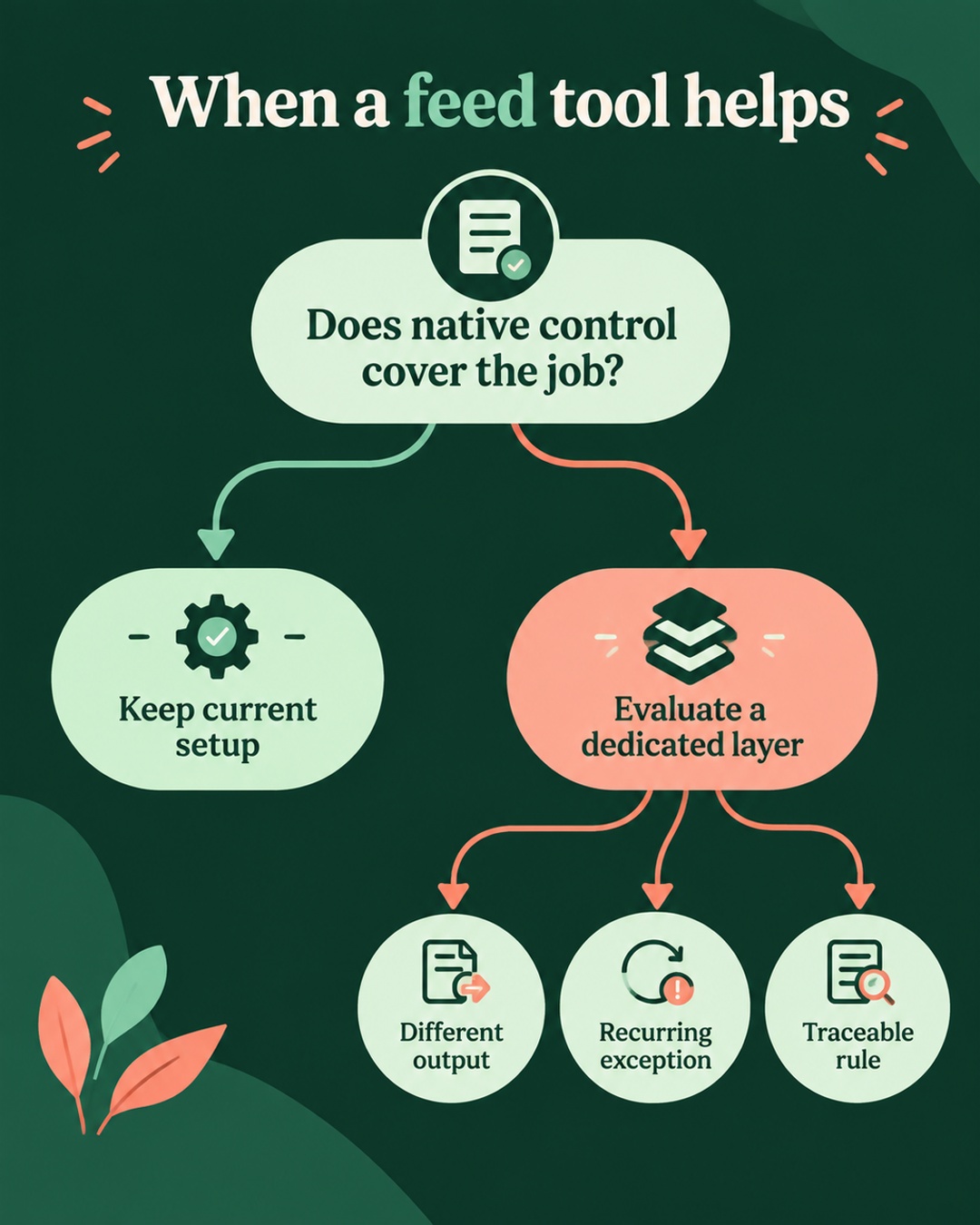
Choosing a feed tool is less about replacing a connector and more about deciding where exceptions should be expressed, tested, and owned. A native control may cover the simple path. Dedicated transformations become useful when one source catalog must produce different, traceable outputs for different destinations.
Start with the installed connector
A native connector can be enough when the catalog is clean, the destination requirements are similar, and product selection is straightforward. Some Shopify native channels, for example, may support product selections, optimized titles or descriptions, and error diagnostics. Those capabilities vary by destination and account, so inspect the actual installation before assuming it is limited.
Document what the connector can do. Check whether it can include or exclude product groups, change selected fields, preserve variant relationships, surface item-level errors, and show the last sync or validation state. The exact controls matter more than the label "native".
Use an exception-heavy group as the test
A broad catalog audit can hide the real decision. Choose one hypothetical product group with several conditions. For example, imagine a retailer selling insulated bottles in several colors and sizes. The source catalog contains one base title, a variant identifier, price, stock status, image URLs, brand, and product type.
Google may require accurate price and availability that match the landing page and checkout. Genuine identifiers, variant data, and accessible product images also matter. TikTok catalog product parameters include sku_id, title, description, availability, condition, price, link, image_link, and brand. The sku_id must remain stable across updates. Its documented availability examples use values such as "in stock" and "out of stock". Amazon Listings Items uses schema-based attributes whose requirements depend on product type and marketplace.
This hypothetical group is useful because it exposes different contracts without pretending that one platform's field values work everywhere.
Separate source fixes from transformations
Some problems belong in the source catalog. If the brand is wrong for every destination, correct the source. If a product image URL is inaccessible, repair the asset or URL. If the landing page price is wrong, fix the offer and checkout data.
Other requirements are destination transformations. A title may need a channel-specific structure. A product group may need to be excluded from one destination. Availability may need a destination-specific enum or label. A source product type may need mapping to a marketplace schema.
Keep policy and account issues in their own lane. A transformation cannot resolve every disapproval, account suspension, or eligibility decision. Platform validation can identify data problems, but it cannot guarantee approval or higher performance.
| Decision area | Native control may fit | Dedicated transformation may fit |
|---|---|---|
| Selection | Simple inclusion or exclusion | Rules based on product group, market, or condition |
| Titles | One approved optimization setting | Different structures by destination |
| Availability | Source value already matches | Destination-specific value mapping |
| Identifiers | Stable, genuine source identifiers | Validation and exception routing |
| Marketplace fields | Connector exposes required fields | Schema-driven conditional attributes |
| Ownership | One team can review diagnostics | Multiple owners need an audit trail |
Create an exception register
Every non-default rule should be traceable. A useful register does not need to be complicated. Record the product group, destination, market, source field, condition, output, owner, validation method, and review date.
- Product group: insulated bottles, clearance items, or a variant family
- Destination: Google, TikTok catalog, Amazon marketplace, or another channel
- Source field: title, price, availability, sku_id, image_link, or product type
- Transformation: mapped value, rewritten title, inclusion rule, or exclusion
- Owner: the person responsible for reviewing changes
- Validation: destination diagnostics, landing-page comparison, or schema check
This register changes the conversation from "the feed looks wrong" to "this output came from this rule, using this source field, and this owner can verify it".
Validate each destination on its own terms
Compare price and availability with the landing page and checkout. Review genuine identifiers, variant relationships, product images, and item-level diagnostics. Accurate data supports eligibility, but validation does not guarantee approval, serving, or higher return.
TikTok catalog data
Keep sku_id stable so updates continue to refer to the same item. Use the documented parameter names and availability examples. Titles should not contain promotional text. Confirm that links and images are accessible and that price and stock agree with the landing page.
Amazon Listings Items
Validate against the product type and marketplace schema. Required, conditional, enum, and type rules can vary. Initial synchronous validation may accept a submission while later asynchronous processing reports issues. Treat acceptance as one checkpoint, not proof of displayed content, buyability, Featured Offer status, or eligibility.
Make the decision with a controlled pilot
Pick the exception-heavy group and run the same source records through the native connector and any proposed transformation workflow. Compare the outputs field by field. Record which rules are visible, which changes persist after a sync, and whether each owner can explain the result.
- Export a small, representative product group.
- List destination requirements from official documentation.
- Mark source corrections separately from transformations.
- Configure the simplest native controls first.
- Add dedicated rules only for remaining exceptions.
- Validate links, images, prices, availability, identifiers, and schemas.
- Record submission status and later processing issues separately.
- Assign an owner and review date to every rule.
Useful references include the Google Merchant Center product data specification, TikTok's catalog product parameters, and Amazon's Listings Items API issue troubleshooting.
Three questions to ask before switching tools
Can the current connector express the exception?
Check the installed controls, not a generic feature list. If the connector can select the products, transform the needed fields, show diagnostics, and preserve the result through later syncs, a separate tool may add unnecessary complexity.
Is the problem data quality, transformation, or policy?
Fix incorrect source data at the source. Use transformations for destination-specific output. Route account and policy issues to the platform remedy. Mixing these categories makes ownership unclear.
Can someone trace the output later?
For every exception, the team should be able to identify the source field, rule, owner, validation evidence, and review date. If that trail is missing, changing tools alone will not solve the governance problem.
The best setup is the smallest one that can express the required rules clearly. Keep simple, well-supported cases in the native connector. Add dedicated transformations when destination differences, exception volume, or ownership requirements justify them. Then validate each output against the platform's own requirements.