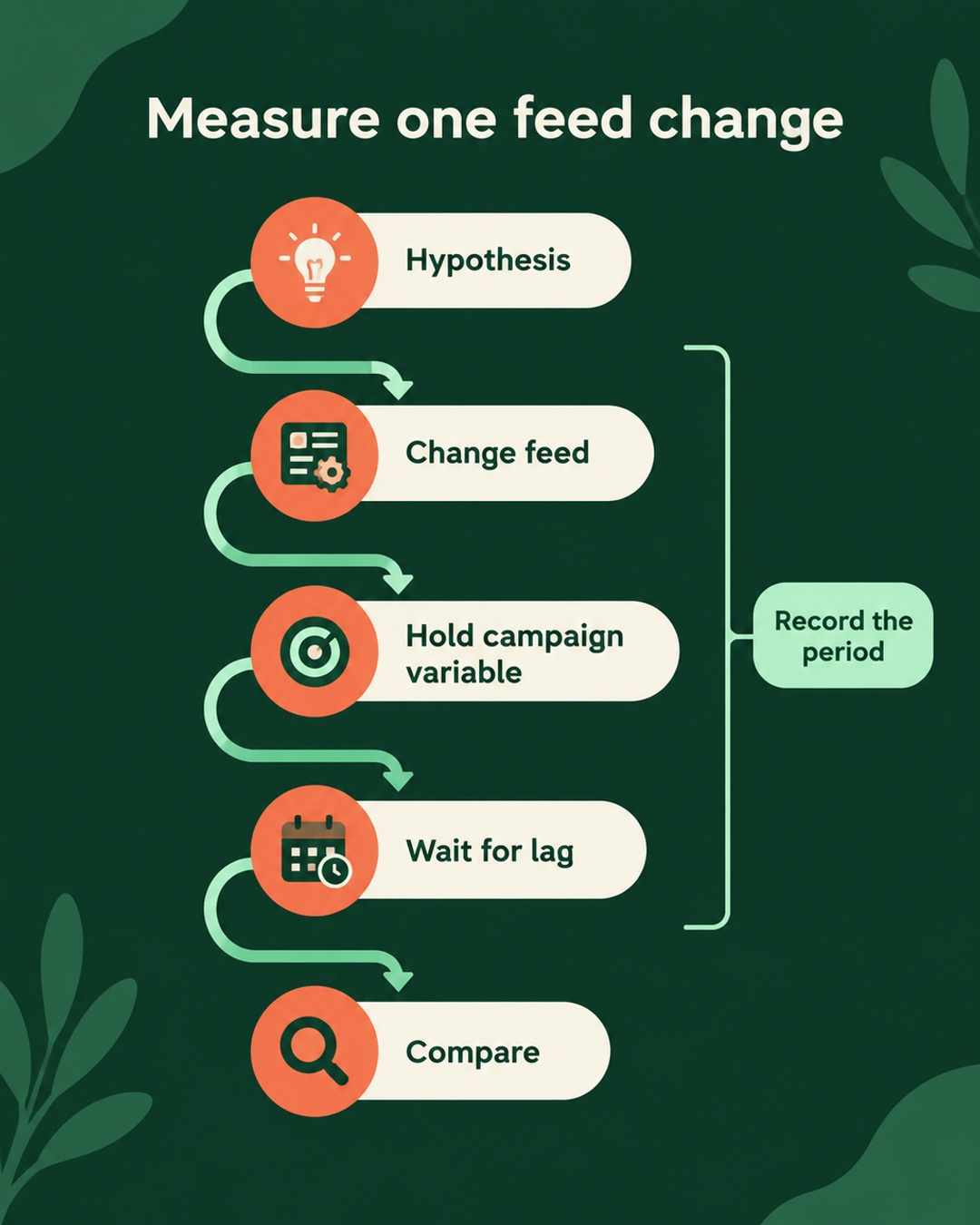
Feed changes should be measured without confusing eligibility, attribution, and profit. The reliable workflow begins with a real item and a precise question. What state is the item in, which source controls the value, and what evidence will show that the correction reached the destination?
Start with the item state
Choose one affected item rather than rewriting the entire catalog. Record its SKU, variant, current price, availability, destination, and the exact message shown by the platform. A product data error belongs in the product data workflow. A landing page mismatch needs a page or checkout correction. A policy or account problem needs the platform's policy or account remedy.
Correct the authoritative source
Find the field that owns the value. Do not patch an exported file and assume the source will stay fixed. For a price or availability issue, compare the feed with the landing page, structured data, and checkout. For a variant issue, check the identifier, title, image, and option values together. Keep genuine identifiers genuine. Never create a GTIN to satisfy a field.
Read the response in stages
A request completing is only one event. Platforms can validate a submission, process it later, and report another issue after downstream checks. Record the submission or job result, then inspect the item-level diagnostics. The absence of an immediate error does not prove that the customer-facing page, offer, eligibility, or advertising status is correct.
Use a small verification record
| Check | Evidence | Owner |
|---|---|---|
| Source | Original and corrected field | Catalog owner |
| Processing | Request and issue state | Channel owner |
| Destination | Live page and offer | Commerce owner |
| Measurement | Campaign and margin context | Marketing owner |
Keep adjacent decisions separate
A feed correction can make an item eligible to be reviewed. It cannot guarantee approval, impressions, conversions, ROAS, a Featured Offer, or profit. Those outcomes depend on additional platform rules, account conditions, customer behavior, attribution windows, costs, and returns. Treat each claim as a separate measurement question.
Hypothetical example
Suppose a retailer sees a product warning after changing a variant title. The team records the item and message, checks the product type requirements, compares the title and identifier with the landing page, corrects the source, and waits for processing. It then inspects the issue state and live detail page. Only after that does the team decide whether a campaign or merchandising change is warranted. The example is hypothetical. The useful part is the sequence and the evidence.
FAQ
Does acceptance prove the listing is live?
No. Later processing issues and live-page conditions still need checking.
Should every error be fixed in the feed?
No. Identify whether the source, page, policy, account, or marketplace owns the problem.
Can better data guarantee better advertising results?
No. Better data can remove a data problem while performance remains a separate question.
Sources
Official platform documentation explains the relevant requirements and processing boundaries. Use the current schema, diagnostics, and account guidance for the destination you operate.
Keep the record
Record the source value, correction, processing response, and customer-facing result together. This makes the next review concrete and prevents a general job status from being mistaken for proof that every item is ready. Keep the identifier unchanged while checking the same variant at each stage, and assign the follow-up to the owner who can correct that part of the workflow. Include the timestamp, destination, marketplace, account, and issue message in the record. If a later reviewer sees a different state, they can tell whether the source changed, the destination processed a new request, or the item was examined under a different account condition. This is useful when a correction appears successful in an export but remains absent from the live page. A short evidence trail also keeps campaign decisions separate from catalog repairs. The team can then decide which owner acts next instead of repeating the same upload without a diagnosis. Include the destination name and exact item state so a general catalog status cannot hide one rejected variant. Preserve the platform message and attribute name when issue details are available. If the page is correct but the item remains unavailable, review account and policy conditions separately. If the account is healthy but the page disagrees, return to the source and checkout. This gives the next reviewer enough context to reproduce the check.
Build a repeatable review
Write down the source value before making a correction, then record the corrected value and the time of the change. Note which connector, marketplace, account, or campaign received the update. This small record prevents a team from confusing a successful request with a successful customer-facing result. It also makes a later review faster because the owner can compare the original item with the response instead of reconstructing the sequence from memory. Check the same identifier at every stage. If the identifier changes, the apparent correction may belong to a different variant. If the identifier stays the same but the value does not change, inspect processing state, cache timing, mapping rules, and any destination-specific requirements. Use the platform diagnostic message as evidence, not as a general verdict about the entire catalog. A clean item can coexist with an account problem, and an eligible account can still contain a broken page. Keep those findings separate in the issue record. When the correction is visible, capture the destination state and close the loop with the owner. If performance changes later, use the saved record to decide whether the timing supports a relationship or whether other campaign and merchandising changes occurred at the same time. The discipline is useful because it turns an abstract feed problem into a sequence of observable checks.