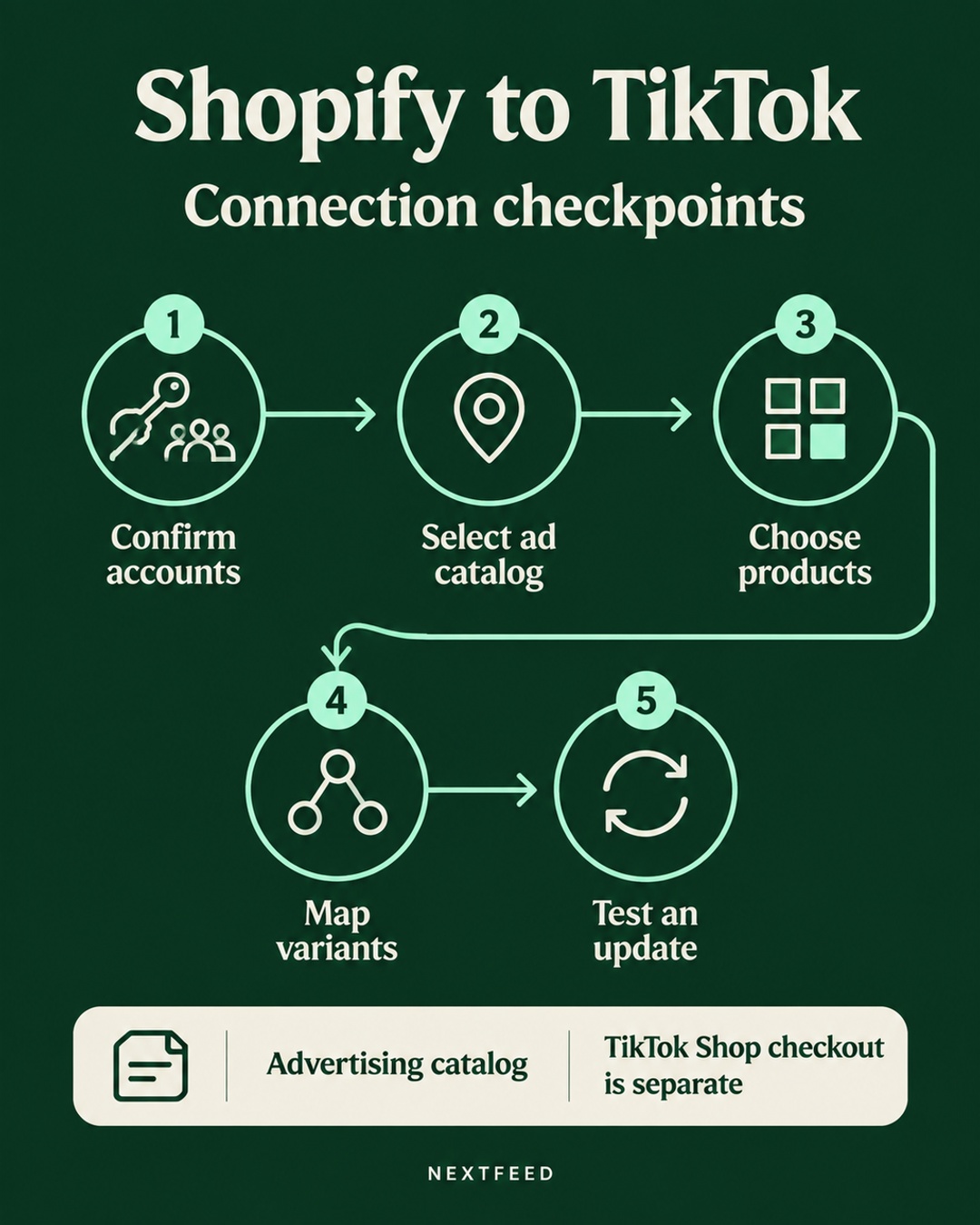
Shopify to TikTok: Verify the First Catalog Sync
A practical guide to checking account ownership, catalog destination, product selection, variant mapping, and the first Shopify change sent to TikTok.
Feed operations knowledge
Technical playbooks and strategy guides for merchants who want fewer disapprovals, better titles, and cleaner feeds.
Free feed check
Upload a catalog and see what Google, Meta, or TikTok may reject before you launch.
Start Free TrialGoogle Shopping
Improve product title structure, keyword coverage, and variant details for better Shopping visibility.
Read guideShopify + Google
Set up Shopify, connect Merchant Center, and troubleshoot sync blockers.
Read guide
A practical guide to checking account ownership, catalog destination, product selection, variant mapping, and the first Shopify change sent to TikTok.
Trace one variant from source record to TikTok catalog, landing page, and checkout before expanding your advertising catalog.
A practical guide to deciding when Shopify native sync is enough and when an additional feed-management layer can improve control across channels and markets.
You are staring at a spreadsheet of 40,000 SKUs, four ad channels, and a feed tool that choked on variant pricing last Black Friday. Picking the wrong product feed tool for Shopify is not a inconvenience. It is a tax you pay every day in disapproved products, wasted ad spend, and hours of manual cle
You run a Shopify store and you want those products in Google Shopping ads, but the path from your admin to Google Merchant Center is not obvious. Do you use the native Google and YouTube channel, install a feed app, or build something custom? The answer depends on what your catalog actually demands
You sell the same products on Google Shopping and Meta Ads, but your product feed keeps getting disapproved on one and accepted on the other. The core data is identical, so you are left wondering why two channels treat the same catalog so differently.
You exported your catalog to every channel and assumed identical data would work everywhere. Now Google Merchant Center is flagging missing GTINs, Meta rejected your variant structure, TikTok Shop cannot parse your categories, and Amazon's listings are stuck in search limbo. One catalog does not mea
You exported one feed from Shopify, pointed it at Google Merchant Center and Meta Commerce Manager, and watched both platforms complain about different things. Same products. Same data. Two different sets of rejections. The problem is not your catalog. It is the assumption that one feed serves two a
You opened Merchant Center this morning and half your feed is flagged for missing GTINs. The dashboard makes it sound like every product needs one. It does not. The rule is narrower than the warning suggests, and merchants who understand the actual boundary stop guessing and start fixing the right r
Your Google Merchant Center dashboard lights up with a missing-GTIN warning and the first instinct is to paste a barcode into the feed so the error goes quiet. That impulse is exactly what gets accounts suspended. The fix has nothing to do with speed and everything to do with provenance.
You stare at the Google Merchant Center feed spec, see "gtin" required, and wonder whether the barcode on the box is the same thing as the SKU in your Shopify admin. You are not alone. GTIN is the single most misunderstood field in product feeds, and guessing wrong here gets your items paired with s
Your Shopify store has 20,000 products and they look perfect on your site. Now you need those same products on Google Merchant Center, Meta, TikTok Shop, and Amazon, and every platform wants the data shaped differently. One catalog is not enough. You need a product data feed.
Start a free trial and see what NextFeed finds in your catalog.